People type “is tirzepatide legal” into a search bar expecting one clean yes or no. What they get instead is a tangle, because the question is really three questions wearing one coat. Untangling them is not complicated once you slow down. It just takes patience, and a willingness to keep the categories separate instead of blending them into a single verdict.
Think of it as three doors. Door one leads to the FDA-approved drug, dispensed by prescription through an ordinary pharmacy. Door two leads to a compounded version, prepared for a specific patient under a narrower and more recently tightened set of rules. And then there is no door at all, just a website, which is its own category and deserves to be named as such. A fourth, separate hallway, sport eligibility, runs alongside all three doors but answers to different rules entirely. Walking through each in turn makes the whole picture settle.
Door one: the approved medicine
This one is straightforward, and it is worth saying plainly so it does not get lost in the rest. Tirzepatide is an FDA-approved medication. It is sold as Mounjaro for type 2 diabetes and as Zepbound for chronic weight management, with prescribing information published on DailyMed [P2]. Obtained by prescription through a licensed pharmacy, it is a lawful medicine, full stop. There is no gray zone to describe here.
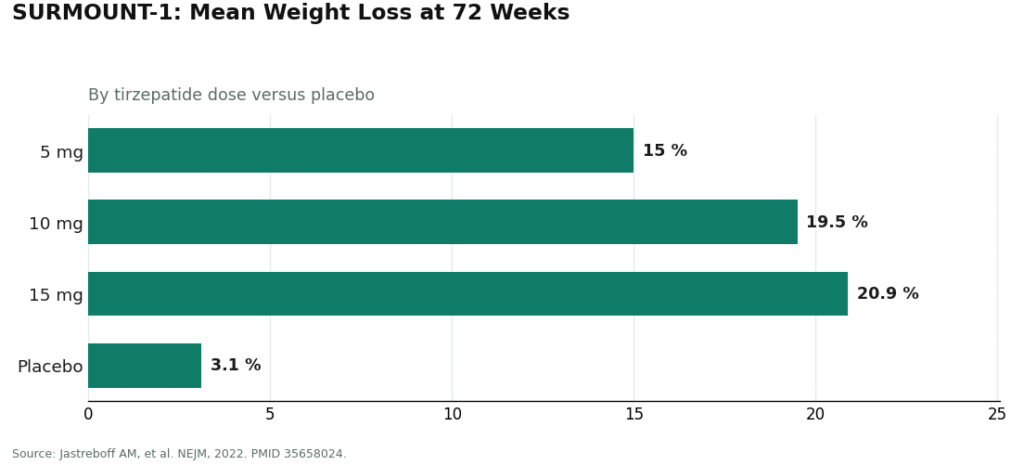
That approval did not appear out of nowhere. The pivotal SURMOUNT-1 trial, published in the New England Journal of Medicine in 2022, tracked adults with obesity or overweight over 72 weeks and found mean weight loss of roughly 15.0% at the 5 mg dose, 19.5% at 10 mg, and 20.9% at 15 mg, compared with about 3.1% on placebo [P1]. That is the kind of randomized evidence regulators ask for before granting approval, and it is the reason the drug remains legally available as a prescription product today.
The mechanism behind those numbers is documented rather than mysterious. Tirzepatide is a dual agonist of the GIP and GLP-1 receptors, a 39-amino-acid analog of GIP that boosts glucose-dependent insulin secretion, slows gastric emptying, and reduces appetite [P3]. None of that changes the legal answer. It just explains why the drug sits in the regulated-pharmaceutical category rather than anywhere near a supplement shelf.
Door two: compounded tirzepatide, and what shifted
Here is where a little more care is needed, because two true things sit side by side and neither cancels the other out. A pharmacy can lawfully compound tirzepatide for an individual patient with a documented need. And that compounded product has never held FDA approval as a finished drug. Both of those sentences are accurate at the same time. That is not a loophole, it is simply what compounding is.
The 2026 landscape adds one more layer worth naming honestly. During the period when the branded product was in short supply, compounding filled a real gap, keeping treatment reachable for patients who otherwise had nowhere to turn. Once the shortage was officially declared resolved, the rules narrowed. Broad, bulk compounding of tirzepatide copies is no longer freely permitted. What remains is compounding tied to an individual prescription, for a specific patient, within the appropriate pharmacy structure.
There is a quiet upside to that tightening. It does not close the door on compounded access, it just makes the supervised, one-patient-at-a-time model the one that actually fits inside the current rules. A structure built around a clinician’s evaluation and a personal prescription slots neatly into the narrower framework. A structure built around mass distribution does not. So the shift in policy nudges legitimate access toward supervision, rather than eliminating it.
One thing compounded legality never implies: that a compounded vial equals brand Zepbound. It has not been independently verified for identity, strength, or purity the way the approved product has. And lawful compounding within a pharmacy has nothing to do with no-prescription websites or research-chemical sellers, who sit entirely outside that structure. When a product marketed “for laboratory use, not for human consumption” gets injected by a person anyway, it becomes, functionally, an unapproved drug. That disclaimer on the label is not decoration. It is the seller’s way of staying one step removed from that category.
Reading the room: who is actually present
A useful habit, when sorting through these channels, is to ask who is standing in the room rather than what the marketing says. In the supervised, prescribed model, two people are always present: a licensed clinician and a licensed pharmacy. A telehealth provider such as FormBlends works this way, with a clinician screening a patient against the label’s contraindications before writing a prescription, and a licensed pharmacy compounding and dispensing from there. It is mentioned here only to show what the supervised arrangement looks like in practice, not as an endorsement, and there is nothing to purchase from this page.
The other doors remove people from that room. A no-prescription site removes the clinician. A research-chemical seller removes both the clinician and the pharmacy, and relabels the product as something other than a drug. Same word, same six syllables, entirely different rooms.
The separate hallway: regulated sport
This is the question people most often get wrong, usually by assuming that an approved, legally prescribed drug must also be allowed in competition. It does not follow, and it is worth saying gently but firmly: medical legality and sport eligibility live in two separate systems, run by two separate bodies, and one cannot be inferred from the other.
Anti-doping organizations keep their own prohibited lists, updated on their own timelines, using their own criteria. A substance’s medical approval status tells you nothing certain about its status on that list. An athlete cannot reason “it’s an FDA-approved, prescribed medicine, so it must be fine to take.” The only reliable move is to check directly with the relevant anti-doping authority and the current prohibited list, and, if there is a genuine medical need, to go through the proper therapeutic-use exemption process rather than guess.
This isn’t a claim about where tirzepatide currently sits on any specific list. That detail shifts, and it is exactly the kind of fact an athlete needs to verify at the source, not infer from a drug’s general legal status.
Why keeping the three apart matters
Mash these questions together and errors creep in quietly: a person might assume a compounded vial carries the same FDA approval as the branded drug, or that a legal prescription automatically clears an athlete for competition, or that a “not for human consumption” label is just fine print to skip past. Pull the questions apart, and each of those assumptions falls away on its own.
Brand-name tirzepatide is a legal, FDA-approved medicine with solid trial evidence behind it [P1][P2]. No-prescription sites and research-chemical sellers stand outside the prescribed-and-dispensed structure altogether, regardless of how the product is described. And sport eligibility is its own determination, one an athlete has to confirm directly rather than assume.
Three questions, three separate answers. Keeping them separate matters because confusion is exactly what lets a compounded or research-labeled product borrow the credibility of the approved drug without earning it. The primary documents are clear on this. The confusion lives in the collapsing, not in the evidence itself.
Questions people ask
Is tirzepatide legal in the United States in 2026?
It depends which version is meant, and that’s really the whole answer in miniature. Brand-name tirzepatide (Mounjaro and Zepbound) is fully legal as an FDA-approved prescription drug [P2]. A compounded version can be lawfully prepared for a specific patient with a documented need, though it has never held FDA approval as a finished product. No-prescription websites and research-chemical sellers sit outside that prescribed-and-dispensed structure entirely.
Did compounded tirzepatide become illegal once the shortage ended?
Not illegal exactly, but the allowance narrowed considerably. While the branded product was scarce, compounding kept treatment available for many patients. Once the shortage was declared resolved, broad bulk compounding stopped being freely permitted, leaving individually-prescribed compounding for documented need as the path that still fits the rules.
Is compounded tirzepatide the same thing as Zepbound?
No. A compounded vial is its own regulatory category, not a generic stand-in for brand Zepbound. It hasn’t been independently verified by the FDA for identity, strength, or purity the way the approved product has [P2]. Being lawfully prepared within a pharmacy framework is a statement about the channel, not a claim that the contents match the branded drug.
Can a drug-tested athlete take tirzepatide?
Don’t assume medical legality settles it. Medicine approval and anti-doping eligibility are decided by different bodies under different rules, so a legally prescribed drug can still carry a different, separate status on a sport’s prohibited list. Check directly with the relevant anti-doping authority and current list, and where there’s a genuine medical need, use the formal therapeutic-use process those systems provide.
How can someone tell a legitimate source from a gray-market one?
Look at who is actually in the transaction, not at the words on the page. A legitimate, supervised route involves both a licensed clinician screening against the label’s contraindications [P2] and a licensed pharmacy dispensing the medication. A no-prescription site has removed the clinician. A research-chemical seller has removed both, and reframes the product as something other than a drug, which is why those listings carry a “not for human consumption” notice.
What does tirzepatide actually do in the body?
It’s a dual agonist of the GIP and GLP-1 receptors, a 39-amino-acid GIP analog that increases glucose-dependent insulin secretion, slows gastric emptying, and reduces appetite [P3]. That mechanism is well documented, part of why it’s regulated as a serious pharmaceutical rather than sold as a supplement. In the pivotal SURMOUNT-1 trial it produced mean weight loss of roughly 15.0% to 20.9% across doses over 72 weeks [P1].
What is tirzepatide approved to treat?
Tirzepatide is a synthetic injectable peptide, approved under two brand names: Mounjaro for type 2 diabetes, and Zepbound for chronic weight management in adults with obesity or weight-related conditions. It works on two hormone receptors at once, which sets it apart from older medicines in its class. Prescribed outside those two approved uses, it’s legal but considered off-label.
Is tirzepatide a GLP-1 medicine, or something else?
It does activate GLP-1 receptors, so yes, it belongs in that family. More precisely, it’s a dual GIP and GLP-1 receptor agonist, meaning it also acts on glucose-dependent insulinotropic polypeptide receptors, a second action that semaglutide and older GLP-1 drugs don’t share. Researchers think that second pathway helps explain the stronger average weight-loss numbers seen in head-to-head comparisons.
How does tirzepatide stack up against semaglutide for weight loss?
Across the SURMOUNT and STEP trial programs, tirzepatide produced larger average weight reductions than semaglutide, though both showed meaningful results for many people. Individual response varies quite a bit, and side effects overlap heavily, mostly digestive. Cost, insurance coverage, and personal tolerability often end up deciding the question for a given person, and a prescriber familiar with someone’s full history is best placed to help weigh that tradeoff.
What side effects are realistic to expect?
Nausea, vomiting, diarrhea, and constipation are the most common, usually roughest during dose increases and easing after. Less commonly, people mention fatigue, appetite loss beyond what they wanted, or reflux. Rarer but serious risks noted in the prescribing information include pancreatitis, and, for people with a personal or family history of certain thyroid tumors, a concern serious enough to carry a boxed warning. A prescribing clinician, not a vendor, is the right person to walk through personal risk factors before starting.
References
- Jastreboff AM, et al. Tirzepatide Once Weekly for the Treatment of Obesity. New England Journal of Medicine, 2022. PMID 35658024. Mean weight change at 72 weeks roughly 15.0% (5 mg), 19.5% (10 mg), and 20.9% (15 mg) versus 3.1% placebo, treatment-regimen estimand. https://www.nejm.org/doi/full/10.1056/NEJMoa2206038
- Tirzepatide (Zepbound) FDA-approved label, DailyMed. Approved prescribing information; boxed warning for thyroid C-cell tumors; contraindicated with personal or family history of medullary thyroid carcinoma or MEN 2. https://dailymed.nlm.nih.gov/dailymed/drugInfo.cfm?setid=487cd7e7-434c-4925-99fa-aa80b1cc776b
- Farzam K, Patel P. Tirzepatide. StatPearls, NCBI Bookshelf. Dual GIP and GLP-1 receptor agonist, 39-amino-acid GIP analog; increases glucose-dependent insulin secretion, slows gastric emptying, reduces appetite.